I the People (Rhetoric, Culture, and Social Critique) by Johnson Paul Elliott
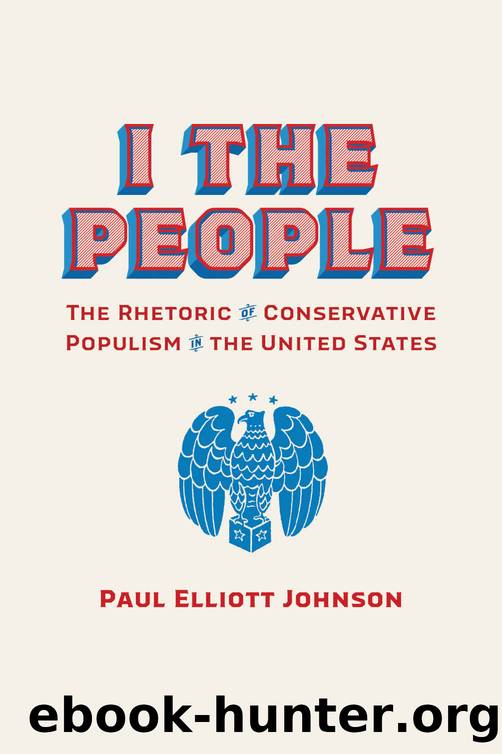
Author:Johnson, Paul Elliott [Johnson, Paul Elliott]
Language: eng
Format: epub
ISBN: 9780817393809
Publisher: University of Alabama Press
Published: 2022-01-25T00:00:00+00:00
6
Donald Trump, White Masculinity, and the Challenge to Populism
INTRODUCTION
Whether launching his campaign, Tweeting, giving stump speeches, or debating other GOP presidential candidates, Donald Trumpâs rhetoric when running for president of the United States in 2016 can be characterized as gratuitously offensive. Mexicans were mostly rapists; former Fox News anchor Megyn Kelly could not be trusted because âshe has blood coming out of her whateverâ; Republican Senator John McCain was a loser because he was captured and tortured by North Vietnamese forces; there should be a âshutdown of Muslims entering the United Statesâ; and the Trans-Pacific Partnership trade agreement threatened to ârapeâ America. 1 Trumpâs comments did not derail his candidacy; he emerged victorious against Hillary Rodham Clinton. Not even a video leaked in October 2016 in which Trump bragged about nonconsensually grabbing women âby the pussyâ could stop his ascent. His eventual electoral victory was a cold reminder that, in the United States, many people can tolerate, even admire, someoneâs capacity to treat others like objects. 2 Trump promised to âmake America great againâ by defining national excellence in opposition to humiliation, violation, and abjection.
Trumpâs populist subjects feel sovereign by imagining that their feelings of injury and self-definition are one and the same, an emotional condition political theorist Elizabeth Anker calls âfelt powerlessness.â Subjects of felt powerlessness oscillate between feeling subjugated and empowered to sustain sublime intensities that fuel their imagination of themselves as both subject and object. 3 Abject figures like the criminal immigrant are a dual-use resource through which members of Trumpâs constituency briefly confront the possibility of their own abjection, react in disgust to reconstitute their own false idea of humanity through the ritualistic objectification of these figures, and then identify with Trumpâs promises of domination in an attempt to manage the threat of being humiliated and injured. The subjects locked into this feedback loop become accustomed to a process of self-definition premised on their individual identity as the start and end of their political and social capacities. As a result, felt powerlessness cuts through objective socioeconomic positionality, enabling a well-off owner of a local car dealership to imagine they share a marginal kinship with an unemployed steelworker or put-upon member of the gig economy by virtue of their joint political exclusion.
By promising to fight for an abused âpeople,â Trump both played into a gladiatorial style central to US conservatism and worked within a broader history of conservative suspicions of consensus politics. 4 He constructed his opponents as part of a broad and powerful political assemblage with several parts. The first of these is the allegedly feminized political system, found both in Trumpâs claims that then-President Barack Obama was soft on immigration and terrorism and in his critiques charging that Hillary Clintonâs 2009â2013 term as secretary of state had weakened the nation, emblematized by the terrorist attack on the American consulate in Benghazi in 2012 that killed US ambassador to Libya Christopher Stevens. 5 Trump regularly attacked the media to figure them as the second vector of
Download
This site does not store any files on its server. We only index and link to content provided by other sites. Please contact the content providers to delete copyright contents if any and email us, we'll remove relevant links or contents immediately.
| Anthropology | Archaeology |
| Philosophy | Politics & Government |
| Social Sciences | Sociology |
| Women's Studies |
The Secret History by Donna Tartt(19092)
The Social Justice Warrior Handbook by Lisa De Pasquale(12191)
Thirteen Reasons Why by Jay Asher(8912)
This Is How You Lose Her by Junot Diaz(6889)
Weapons of Math Destruction by Cathy O'Neil(6281)
Zero to One by Peter Thiel(5802)
Beartown by Fredrik Backman(5756)
The Myth of the Strong Leader by Archie Brown(5509)
The Fire Next Time by James Baldwin(5448)
How Democracies Die by Steven Levitsky & Daniel Ziblatt(5219)
Promise Me, Dad by Joe Biden(5154)
Stone's Rules by Roger Stone(5088)
A Higher Loyalty: Truth, Lies, and Leadership by James Comey(4964)
100 Deadly Skills by Clint Emerson(4927)
Rise and Kill First by Ronen Bergman(4790)
Secrecy World by Jake Bernstein(4753)
The David Icke Guide to the Global Conspiracy (and how to end it) by David Icke(4720)
The Farm by Tom Rob Smith(4514)
The Doomsday Machine by Daniel Ellsberg(4490)
